Voice AI Agents Are Changing How Businesses Handle Phone Calls
Phone calls remain an important customer channel for businesses across healthcare, financial services, home services, SaaS, sales, insurance, real estate, and professional services.
But handling every call manually creates a familiar set of problems: missed calls, long wait times, repetitive questions, slow lead follow-up, and increasing pressure on support teams.
Voice AI agents provide another way to handle these conversations.
Instead of relying on traditional phone trees or sending every caller directly to a human employee, businesses can deploy AI agents that understand natural language, maintain conversation context, take actions, and transfer calls to employees when human involvement is needed.
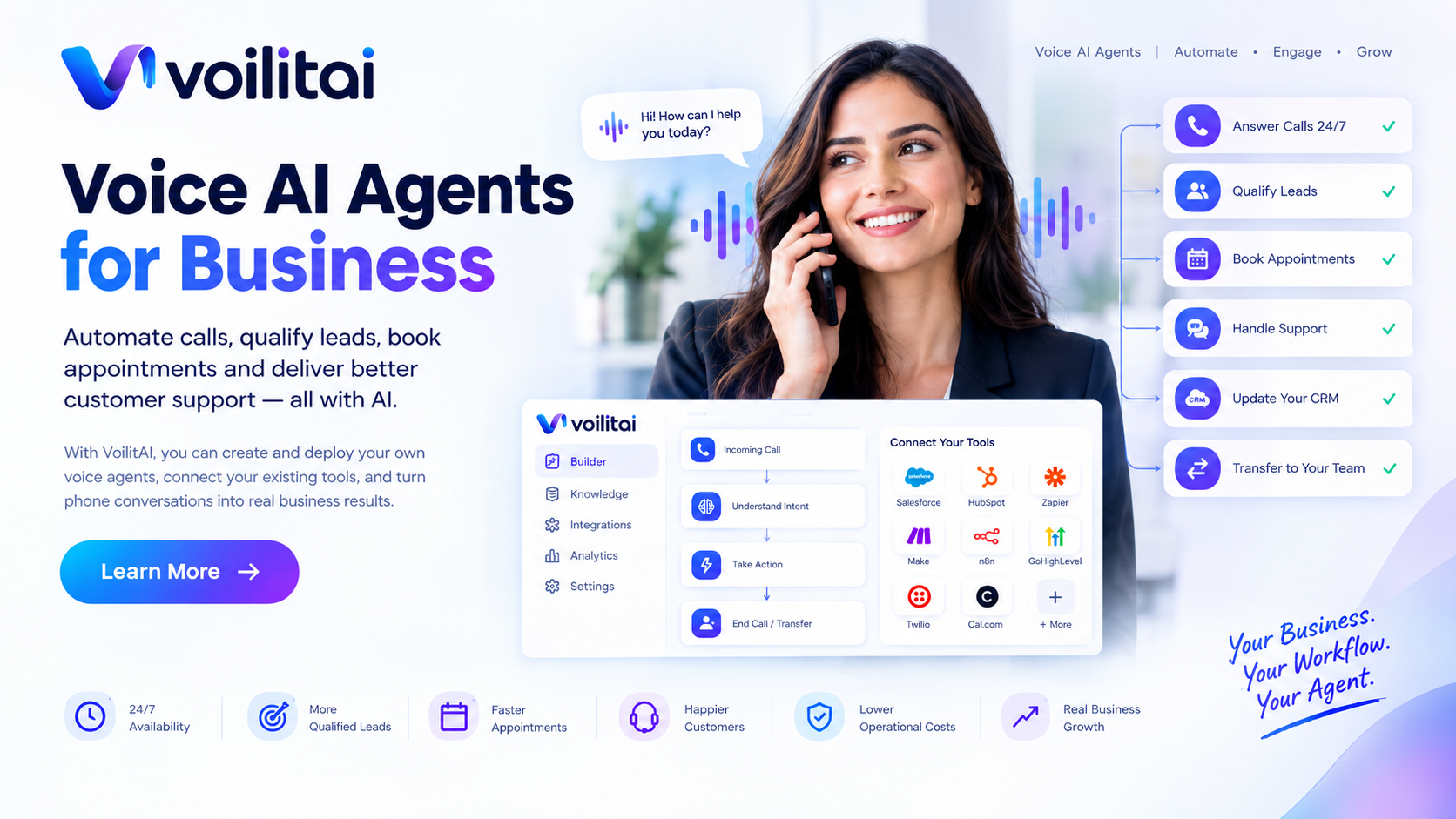
VoilitAI is built around this approach, providing production voice agents that can answer calls, qualify leads, book appointments, update CRMs, and hand conversations to human teams.
What Is a Voice AI Agent?
A Voice AI agent is software that can conduct natural conversations over the phone.
Traditional IVR systems generally rely on predefined menus:
"Press 1 for Sales. Press 2 for Support."
A Voice AI agent works differently.
A caller can simply explain what they need, and the agent can determine the intent and respond accordingly.
For example:
Customer:
"I need to reschedule my appointment for Friday."
Voice AI Agent:
"Sure. Let me check the available times for Friday."
The agent can then interact with the appropriate scheduling system and confirm the new appointment.
According to VoilitAI, its agents can understand language, maintain context across conversation turns, and perform actions such as booking, qualifying, transferring, and updating CRM records.
Why Businesses Are Turning to Voice AI
As call volumes increase, businesses often face a difficult choice: hire more employees or allow customers to wait.
Neither approach solves every problem.
Voice AI can provide an additional operational layer that handles repetitive and predictable conversations while allowing employees to focus on situations requiring human judgment.
Common use cases include:
- Answering inbound calls
- Lead qualification
- Appointment scheduling
- Customer support
- Frequently asked questions
- Customer intake
- Call routing
- CRM updates
- Missed-call recovery
- After-hours support
- Human handoff
VoilitAI specifically positions its voice agents around answering, booking, lead capture, CRM synchronization, and warm human handoff.
- Answer Calls 24/7
Businesses don't only receive calls during convenient working hours.
Customers may call:
- Early in the morning
- During lunch
- After business hours
- On weekends
- During holidays
- When employees are already busy
A Voice AI agent can provide continuous call coverage.
VoilitAI states that its voice agents can answer inbound calls around the clock, including nights, weekends, and overflow periods. Businesses can also keep existing numbers through SIP or provision new numbers.
This can be particularly useful for businesses where phone calls represent high-intent customer interactions.
- Qualify Leads Automatically
Not every incoming call represents the same opportunity.
A sales team may need to determine:
- Who is calling?
- What service do they need?
- What is their budget?
- When do they need the service?
- Where are they located?
- Are they ready to speak with sales?
A Voice AI agent can collect this information during the conversation.
Instead of simply recording:
"Call this person back."
The sales team can receive structured information about the caller and their request.
This creates a more consistent lead intake process and can reduce the amount of manual qualification required from sales teams.
- Book Appointments While the Customer Is on the Phone
Appointment scheduling is one of the clearest Voice AI use cases.
A caller shouldn't necessarily need to:
- Wait for an employee.
- Receive a callback.
- Visit a website.
- Submit a form.
- Wait for confirmation.
A properly configured agent can interact with scheduling tools and complete the booking during the call.
For example:
Caller:
"I'd like to book a consultation next Tuesday."
Agent:
"Sure. I have 10 AM and 2 PM available. Which works better for you?"
The customer receives an answer immediately, while the business can automate the scheduling workflow.
VoilitAI supports connecting calendars and other tools as part of its agent setup.
- Automatically Update Your CRM
One of the biggest advantages of connecting Voice AI with business systems is that the conversation doesn't have to end when the call ends.
The agent can capture relevant information and send it to the CRM.
For example:
Caller Information
- Name
- Phone number
- Company
- Service requested
- Lead status
- Appointment
- Conversation notes
This can help sales and support teams avoid manually entering information after every call.
VoilitAI lists CRM synchronization as one of its core voice-agent capabilities and supports integrations with platforms including Salesforce, HubSpot, GoHighLevel, and others.
- Give Customers Immediate Answers
Many customer calls involve questions that don't require an employee.
Examples:
- "What are your business hours?"
- "Do you offer this service?"
- "Where are you located?"
- "How much does this service cost?"
- "What documents do I need?"
- "Can I reschedule my appointment?"
A Voice AI agent can use a configured knowledge base to answer these questions.
This allows human employees to spend more time handling complex issues rather than repeatedly answering the same basic questions.
- Know When a Human Should Take Over
Automation doesn't mean every conversation should be handled entirely by AI.
Some situations require a human.
For example:
- Complex complaints
- Sensitive customer issues
- High-value sales opportunities
- Requests outside the agent's permissions
- Situations requiring management approval
- Conversations where the customer explicitly requests an employee
A well-designed Voice AI system should recognize these situations and transfer the conversation appropriately.
VoilitAI describes its agents as systems that can determine when a human should take over and provide warm handoffs rather than forcing the AI to handle every interaction.
Voice AI vs. Traditional IVR
The difference between traditional IVR and modern Voice AI is significant.
Traditional IVRVoice AIMenu-basedNatural conversationPress-button navigationUnderstands spoken requestsLimited conversation contextMulti-turn conversationsUsually routes callsCan perform actionsLimited personalizationCan use customer/business contextPrimarily phone routingCan connect with business tools
Voice AI doesn't simply replace the phone menu.
It can become an operational interface between customers and business systems.
Voice AI Should Connect to Your Existing Technology
A Voice AI agent becomes more useful when it can interact with the tools your company already uses.
A business might connect its agent to:
- CRM
- Calendar
- Scheduling platform
- Knowledge base
- Automation platform
- Phone infrastructure
- Customer database
VoilitAI currently lists integrations and connectivity with platforms including Twilio, Salesforce, HubSpot, Zapier, Make, n8n, GoHighLevel, Cal.com, Vonage, Genesys, Five9, Amazon Connect, Telnyx, Avaya, Jobber, and Housecall Pro.
This approach allows the AI agent to become part of the existing workflow rather than another isolated software tool.
How VoilitAI Works
Building a Voice AI agent with VoilitAI follows a straightforward process.
1. Describe the Job
Define what you want the agent to handle.
This can include:
- Services
- Business hours
- FAQs
- Escalation rules
- Business processes
- Connected tools
2. Design the Conversation
Use the visual flow builder or an industry template to structure the conversation.
You can connect calendars, CRMs, and knowledge bases as part of the workflow.
3. Test and Deploy
Before going live, test conversations and review how the agent responds.
VoilitAI describes simulation testing, live analytics, and continuous QA as part of its deployment process.
Simple agents can reportedly go live in hours using templates, while complex enterprise deployments with custom integrations typically take 2–4 weeks with hands-on support.
Voice AI Is Expanding Beyond Phone Calls
Voice is only the beginning.
Businesses increasingly interact with customers through multiple channels:
- Phone
- Website
- Chat
- SMS
VoilitAI's platform is designed around a shared builder, knowledge base, and analytics layer, with chat, SMS, and website voice listed as upcoming channels.
The long-term opportunity is therefore not just creating a phone bot.
It is creating a consistent AI-powered customer communication system across multiple channels.
Which Businesses Can Use Voice AI?
Voice AI can be applied to many industries where phone conversations are an important part of operations.
Healthcare
- Patient intake
- Appointment booking
- Clinic information
- Call routing
- After-hours coverage
Home Services
- Lead capture
- Job qualification
- Appointment scheduling
- Emergency call routing
- Dispatch workflows
SaaS & Customer Support
- Product questions
- Support intake
- Lead qualification
- Demo scheduling
Financial Services
- Customer inquiries
- Intake workflows
- Call routing
- Support automation
Real Estate
- Lead qualification
- Property inquiries
- Appointment scheduling
- Follow-up
Legal
- Initial intake
- Qualification
- Appointment booking
- Call routing
VoilitAI currently highlights healthcare, financial services, insurance, customer support, lead qualification, home services, real estate, and legal workflows among its solution areas.
The Future of Business Calls Is More Than Automation
The goal of Voice AI isn't simply to answer more phone calls.
The bigger opportunity is to make those conversations useful.
A modern AI agent can potentially:
Listen → Understand → Decide → Act → Record → Escalate
That means a phone call can become part of an automated business workflow rather than an isolated conversation.
Instead of:
Call → Employee answers → Employee takes notes → Employee updates CRM → Employee schedules appointment
the workflow can become:
Call → AI understands → AI takes action → CRM updates → Human joins when needed
That's where Voice AI starts becoming an operational system rather than just a chatbot.
Build Your Voice AI Agent With VoilitAI
Businesses don't have to start by replacing their entire customer support operation.
A better approach is to identify one repetitive, high-volume workflow and automate it first.
Start with:
- One business process
- One agent
- One set of responsibilities
- One group of integrations
Then measure the results and expand.
VoilitAI provides a visual builder for creating voice agents, connecting business tools, testing conversations, and deploying agents to phone numbers.
Your business. Your workflow. Your agent.