
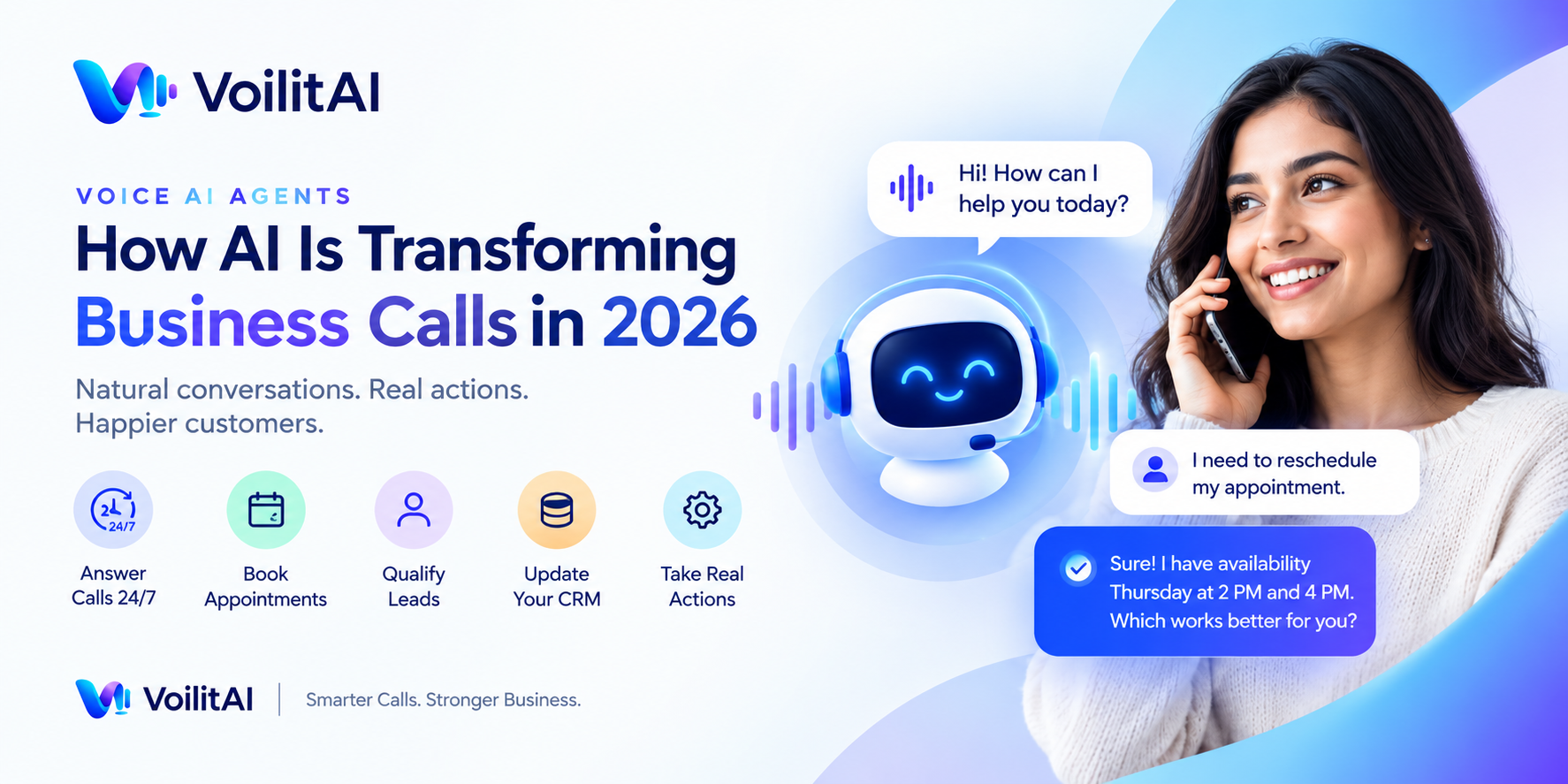
Voice AI Agents: How AI Is Transforming Business Calls in 2026
Businesses have spent years trying to make phone support more efficient. Traditional IVR menus, call queues, voicemail, and large call centers helped solve parts of the problem—but customers still want something much simpler:
Call a business, explain what they need, and get the problem solved.
That is where Voice AI agents are changing the way businesses handle phone calls.
Unlike traditional phone systems that rely on rigid menus and predefined responses, modern Voice AI agents can understand natural speech, maintain context throughout a conversation, take actions in connected business systems, and transfer callers to human employees when necessary.
Platforms such as VoilitAI are making it possible for businesses to deploy these AI-powered phone agents without building an entire voice infrastructure from scratch.
What Is a Voice AI Agent?
A Voice AI agent is an AI-powered software system capable of having natural spoken conversations with customers over the phone.
A traditional IVR might say:
“Press 1 for sales. Press 2 for support. Press 3 for billing.”
A Voice AI agent works differently.
A customer can simply say:
“I need to reschedule my appointment for Friday afternoon.”
The AI can understand the request, identify the customer, check available appointment times, book the new appointment, update the relevant system, and confirm the change—all within the same conversation.
This is the key difference between voice automation and Voice AI agents.
The goal isn't simply to make a machine talk.
The goal is to allow AI to understand, reason, and take action.
Why Voice AI Agents Are Becoming Important
Phone calls remain one of the highest-intent communication channels for many businesses.
A customer calling a business is often looking for something immediate:
- An appointment
- A quote
- Product information
- Technical support
- Order information
- A service request
- A sales consultation
- Billing assistance
When nobody answers, that opportunity can disappear.
VoilitAI's platform is built around this problem: answering calls quickly and allowing an AI agent to handle conversations, perform actions, or escalate the interaction when human assistance is required.
Recent industry discussions also show the shift from basic voice bots toward agents that can actually complete business workflows such as bookings, lead qualification, order status checks, and support tasks.
Voice AI vs. Traditional IVR
Traditional IVR systems are useful for simple routing, but they can become frustrating when customers have to navigate multiple menus.
For example:
Traditional IVR:
- Press 1 for sales
- Press 2 for support
- Press 3 for billing
- Enter your account number
- Wait for an agent
- Explain the problem again
Voice AI agent:
“Hi, how can I help you today?”
“I need to change my appointment from Tuesday to Thursday.”
“Sure. I have availability Thursday at 2 PM and 4 PM. Which works better?”
The second experience is closer to speaking with a receptionist.
Modern Voice AI systems can also maintain conversational context and handle interruptions rather than forcing callers through rigid decision trees.
What Can a Voice AI Agent Actually Do?
The most valuable Voice AI agents don't just answer questions.
They perform tasks.
Depending on the business and integrations, a Voice AI agent can:
1. Answer inbound calls
Your AI agent can answer calls 24/7 instead of sending customers to voicemail when your team is unavailable.
This is particularly useful for businesses receiving calls outside normal working hours.
2. Book appointments
A voice agent can connect with scheduling systems and help customers:
- Book appointments
- Reschedule appointments
- Cancel appointments
- Check availability
- Confirm appointment details
VoilitAI is designed to perform real-time actions such as appointment booking directly during conversations.
3. Qualify leads
Not every caller needs to speak with a salesperson immediately.
A Voice AI agent can collect important information such as:
- Name
- Contact information
- Service required
- Budget
- Location
- Timeline
- Specific requirements
The qualified lead can then be passed to the sales team.
This allows human sales representatives to spend more time on high-value opportunities.
4. Update your CRM
One of the biggest advantages of an AI agent is that the conversation doesn't have to end when the call ends.
The agent can update your CRM with information collected during the call.
For example:
Customer calls → AI understands request → CRM updated → appointment booked → customer receives confirmation
VoilitAI supports integrations with platforms and automation tools including Salesforce, HubSpot, Zapier, Make, n8n, and others.
5. Handle customer support
Voice AI can handle repetitive support requests such as:
- Business hours
- Pricing questions
- Order information
- Service availability
- Basic troubleshooting
- Account questions
- Frequently asked questions
More complex cases can be transferred to a human employee.
6. Transfer calls intelligently
AI doesn't have to handle every conversation.
Sometimes the best outcome is to involve a human.
A good Voice AI system should recognize when the request requires human judgment and transfer the caller with relevant context instead of forcing the customer to repeat everything.
This type of human escalation is an important part of reliable Voice AI deployment.
The Technology Behind Voice AI Agents
A Voice AI conversation involves several technologies working together.
A simplified architecture looks like this:
Caller
↓
Speech Recognition
↓
AI Reasoning
↓
Business Data & Tools
↓
Text-to-Speech
↓
Caller
The challenge is making all of this happen quickly enough to feel like a real conversation.
Latency matters.
If a caller finishes speaking and waits several seconds for the AI to respond, the conversation feels unnatural.
VoilitAI is designed around low-latency voice interactions, with the platform currently advertising response times below 600 milliseconds.
Voice AI Agents Need More Than a Good Voice
A realistic voice is only one part of the experience.
A production-ready Voice AI agent needs to understand:
Context
What has already been said during the conversation?
Intent
What is the customer actually trying to accomplish?
Business rules
What is the agent allowed to do?
Tools
Which systems can the AI access?
Escalation
When should the conversation be transferred to a human?
Knowledge
Where does the agent get accurate business information?
This is why the next generation of Voice AI is moving beyond simple voice bots toward AI agents that can take actions.
Real-World Voice AI Use Cases
Voice AI can be applied across many industries.
Healthcare
Clinics and healthcare organizations can use voice agents for:
- Appointment scheduling
- Patient inquiries
- Appointment reminders
- Call routing
- After-hours support
- Basic administrative requests
For healthcare deployments, security, privacy, access controls, and appropriate escalation are especially important.
Home Services
HVAC companies, plumbers, electricians, and contractors often depend heavily on phone calls.
A Voice AI agent can:
- Answer service calls
- Identify the customer's problem
- Collect the service address
- Qualify the request
- Schedule appointments
- Dispatch or notify staff
- Handle after-hours calls
Instead of hearing voicemail, a customer can immediately interact with an available agent.
Real Estate
Real estate teams can use Voice AI to:
- Respond to property inquiries
- Qualify buyers and sellers
- Schedule property viewings
- Collect requirements
- Follow up with leads
- Route high-value prospects to agents
Financial Services
Financial organizations can use AI voice agents for selected customer-service workflows, provided appropriate security, compliance, and authorization controls are in place.
Potential applications include:
- General information
- Appointment scheduling
- Customer support
- Call routing
- Lead qualification
- Status inquiries
SaaS and Technology Companies
Software companies can use Voice AI for:
- Customer support
- Product questions
- Lead qualification
- Demo scheduling
- Account assistance
- After-hours support
The same AI infrastructure can potentially support voice, chat, and SMS experiences.
Voice AI Doesn't Have to Replace Your Employees
One of the biggest misconceptions about AI agents is that businesses need to replace their entire customer service team.
That's not necessarily the right approach.
A better strategy is to divide work between AI and humans.
AI handles:
- Repetitive questions
- Appointment scheduling
- Lead qualification
- Basic support
- Information collection
- After-hours calls
Humans handle:
- Complex problems
- Sensitive situations
- Exceptions
- Negotiations
- High-value customers
- Decisions requiring human judgment
This creates a human + AI customer service model.
AI handles the repetitive workload while employees focus on conversations where human expertise matters most.
How VoilitAI Works
With VoilitAI, businesses can create and deploy voice agents through a visual workflow rather than building an entire voice infrastructure themselves.
The process can be broken down into three stages.
Step 1: Define the Job
Tell the AI what your business does, how calls should be handled, what information the agent needs, and when it should escalate to a human.
Step 2: Design the Conversation
Build the conversation flow and connect the agent to calendars, CRMs, knowledge bases, and other business tools.
VoilitAI provides a visual flow builder and supports real-time actions during calls.
Step 3: Deploy and Optimize
Connect your phone numbers, test different scenarios, monitor calls, and improve the agent based on real conversations.
VoilitAI also provides simulation testing, continuous QA, and performance analytics to help businesses identify problems and improve their agents over time.
What Makes a Good Voice AI Agent?
Before deploying a Voice AI system, businesses should evaluate more than how realistic the voice sounds.
Look for:
Natural conversations
The agent should understand normal speech rather than requiring specific commands.
Low latency
Responses should happen quickly enough to maintain a natural conversation.
Context awareness
The agent should remember what was said earlier in the conversation.
Real-time actions
The AI should be able to perform useful tasks rather than simply provide information.
Integrations
The agent should connect to the tools your business already uses.
Human handoff
There should be a clear path to a human when AI should not continue.
Analytics
You should be able to understand how your agents are performing.
Testing and QA
Agents should be tested against realistic conversations and edge cases before being trusted with customers.
These capabilities matter because successful Voice AI deployment depends on the entire workflow—not just the quality of the generated voice.
The Future of Voice AI
Voice AI is moving from answering questions to getting things done.
The next generation of business communication will increasingly combine:
- Voice
- AI reasoning
- Business data
- CRM systems
- Scheduling
- Automation
- Analytics
- Human escalation
Instead of simply asking an AI:
“What should I do?”
Businesses will increasingly use AI agents that can actually do the work.
That's the fundamental shift from chatbots and IVR systems to AI agents.
Why Businesses Should Start Now
The biggest advantage of Voice AI isn't necessarily replacing people.
It's availability.
Your business can have an AI agent answering calls when your employees are busy, after hours, during weekends, or when call volume suddenly increases.
Every call can become an opportunity to:
Answer → Understand → Qualify → Act → Record → Follow up
And that is where Voice AI becomes a business system rather than just another chatbot.
Final Thoughts
Voice AI agents are changing how businesses communicate with customers.
The technology has moved beyond scripted phone bots. Modern agents can understand natural conversations, maintain context, connect to business systems, perform actions, and escalate conversations when humans are needed.
For businesses that rely on phone calls for sales, support, bookings, or customer service, the opportunity is significant.
The future of business calls isn't another phone tree.
It's an intelligent AI agent that can actually help.
With VoilitAI, businesses can build, deploy, and scale production-ready voice agents designed to answer calls, book appointments, update CRMs, automate workflows, and keep customers connected 24/7.
Don't let your next customer call go unanswered.