
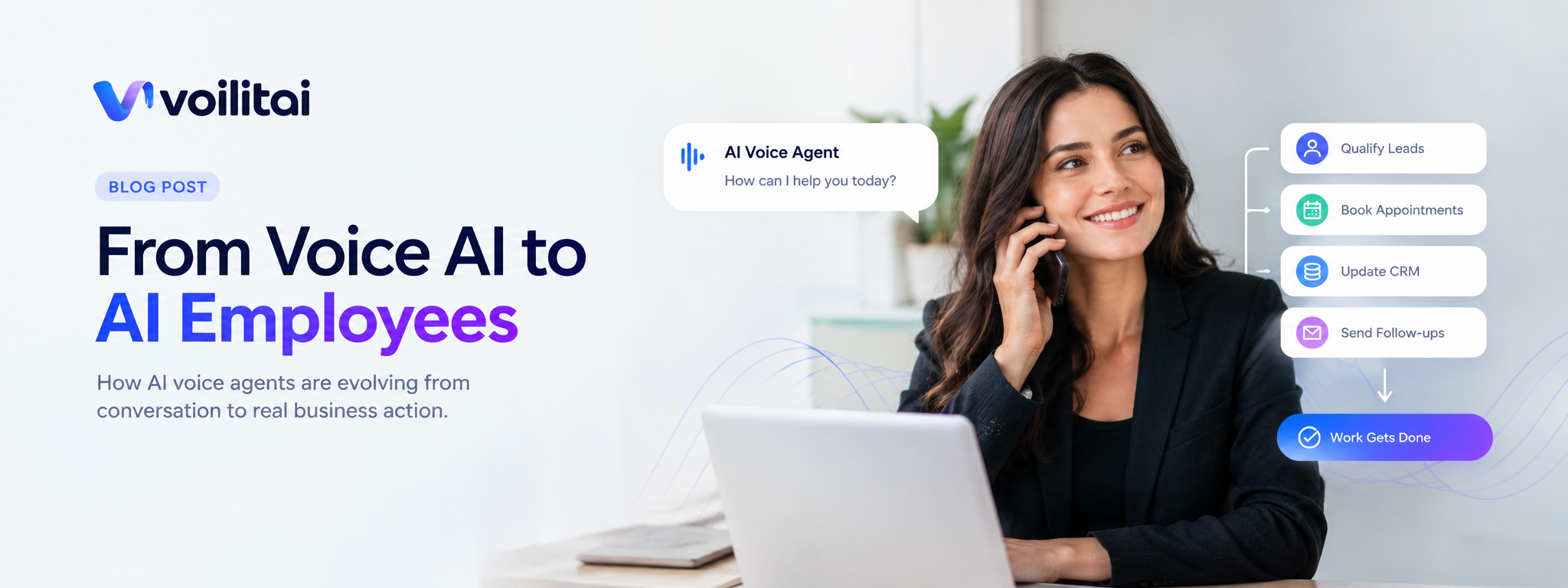
Voice AI Has a New Problem to Solve
For a long time, the promise of Voice AI was simple:
Make an AI that can talk to customers.
And that was impressive.
But businesses don't really need another system that can have a conversation.
They need systems that can get work done.
A customer doesn't call a business just to talk.
They call because they want something:
- An appointment
- An answer
- A quote
- A booking
- A status update
- A service
- A follow-up
- A resolution
That's where the next generation of Voice AI is heading.
The question is no longer:
"Can AI talk like a human?"
The more important question is:
"Can AI understand what the customer wants and actually do something about it?"
The Evolution of Voice AI
Voice technology has gone through several stages.
Stage 1: Traditional IVR
Customers navigate menus:
Press 1 for Sales.
Press 2 for Support.
Press 3 for Billing.
It works, but the experience is rigid.
Stage 2: Conversational Voice Bots
Customers can speak naturally instead of pressing buttons.
The AI can understand questions and provide answers.
Better, but still limited.
Stage 3: Agentic Voice AI
The AI can understand intent, use business tools, make decisions within defined boundaries, and complete workflows.
For example:
Customer:
"I need to move my appointment to next Thursday."
The AI doesn't simply explain how to reschedule.
It can potentially:
Understand → Check calendar → Find availability → Reschedule → Update system → Confirm
That's a completely different category of automation.
Recent industry research is increasingly describing this as agentic voice AI: spoken interaction connected to tools, workflows, context, and human handoffs.
The Real Problem Businesses Are Facing
Businesses don't necessarily have a communication problem.
They have a workflow problem.
Consider a typical customer call.
A customer calls.
An employee answers.
The employee asks questions.
The employee checks a system.
They enter information into a CRM.
They schedule something.
They send a confirmation.
They create a follow-up task.
That's a lot of work surrounding one conversation.
The phone call is only the beginning.
The real opportunity is automating everything that happens because of the conversation.
AI Shouldn't Just Answer. It Should Act.
This is the fundamental shift.
Imagine a customer calling a home services company.
Instead of:
"Yes, we provide AC repair. Someone will call you back."
An AI employee could potentially:
- Understand the customer's problem.
- Ask qualifying questions.
- Capture the address.
- Check availability.
- Schedule a technician.
- Update the CRM.
- Send confirmation.
- Escalate the request if it requires human attention.
The conversation becomes an actionable workflow.
This is why modern voice AI platforms are increasingly focusing on tool use, integrations, context, and task completion instead of voice quality alone.
Why This Matters for Businesses
Every business has repetitive work.
Some of it happens over the phone.
Some happens after the phone call.
Some happens between different software systems.
And much of it doesn't require a human to make every decision.
That's where AI employees can create value.
Sales
An AI can respond to new leads, ask qualifying questions, and schedule meetings.
Customer Support
An AI can handle common questions and collect information before escalating complex issues.
Healthcare
An AI can help with appointment-related workflows and patient intake.
Home Services
An AI can capture job details, qualify requests, and schedule service.
Real Estate
An AI can respond to inquiries, qualify prospects, and schedule viewings.
The technology is becoming less about one generic "AI receptionist" and more about creating specialized AI workers for specific business processes.
The AI Employee Needs Access to Your Business
An intelligent conversation alone isn't enough.
Your AI needs context.
It needs to know:
- What your business does
- What services you offer
- Your policies
- Your availability
- Your customers
- Your workflows
- Which systems it can access
- What actions it is allowed to perform
- When it needs to involve a human
This is why integrations are so important.
The AI should not exist separately from your business.
It should work inside your business workflow.
Human Handoff Is Still Part of Good Automation
AI doesn't need to replace every human conversation.
In fact, good automation knows when not to automate.
A customer might have a complicated complaint.
A sales opportunity might require negotiation.
A sensitive situation might need a manager.
The AI should recognize these situations and bring in the right person.
The best systems create a partnership:
AI handles the repetitive work.
Humans handle judgment, relationships, and exceptions.
Speed Is Becoming Part of the User Experience
There is another important change happening in Voice AI.
People don't want to wait for an AI to "think."
Long pauses make conversations feel unnatural.
That's why latency has become an important benchmark for production voice agents alongside grounding, reliability, and handoff quality.
A good AI voice experience should feel responsive enough that the customer can focus on the conversation rather than the technology behind it.
The Biggest Opportunity Isn't Replacing People
It's giving businesses more capacity.
Imagine a small company that receives hundreds of calls every week.
Instead of immediately hiring additional staff, it could automate predictable parts of the customer journey.
The team can then spend more time on:
- Complex customers
- High-value sales
- Strategic decisions
- Relationships
- Exceptions
- Work that actually requires human judgment
AI becomes a capacity multiplier.
That's a much more useful way to think about AI employees.
Where VoilitAI Fits
VoilitAI is built around this shift.
Instead of asking businesses to build an AI system from scratch, the platform gives them a way to create and configure their own AI voice employees around specific business needs.
You define the role.
You provide the business knowledge.
You design how the conversation should work.
You connect the tools your agent needs.
Then you put the agent to work.
The goal isn't to create another chatbot.
The goal is to create an AI employee that can participate in an actual business process.
Build your AI employee with VoilitAI
Start With One Job
Businesses don't need to automate everything at once.
Start with one repetitive problem.
For example:
"Answer our incoming calls."
Then:
"Qualify our leads."
Then:
"Book appointments."
Then:
"Update our CRM."
Then:
"Handle follow-ups."
Each step creates a more capable AI workforce.
The most successful implementations won't necessarily be the companies with the most AI.
They'll be the companies that identify the right work for AI to perform.
The Future Is AI That Works, Not AI That Just Talks
Voice AI has already crossed an important threshold.
The technology can now do much more than recognize speech and generate a response.
The bigger opportunity is connecting conversation with knowledge, tools, workflows, and action.
That changes the role of AI.
It stops being just a voice interface.
It becomes an employee.
And for businesses, that's where the real value begins.
The future of Voice AI isn't just better conversations.
It's getting work done through conversations.